
L8ER SK8ER
An Interview with Elie Lichtschein


Word Count: 109,000
Genre: YA Horror
Book Blurb
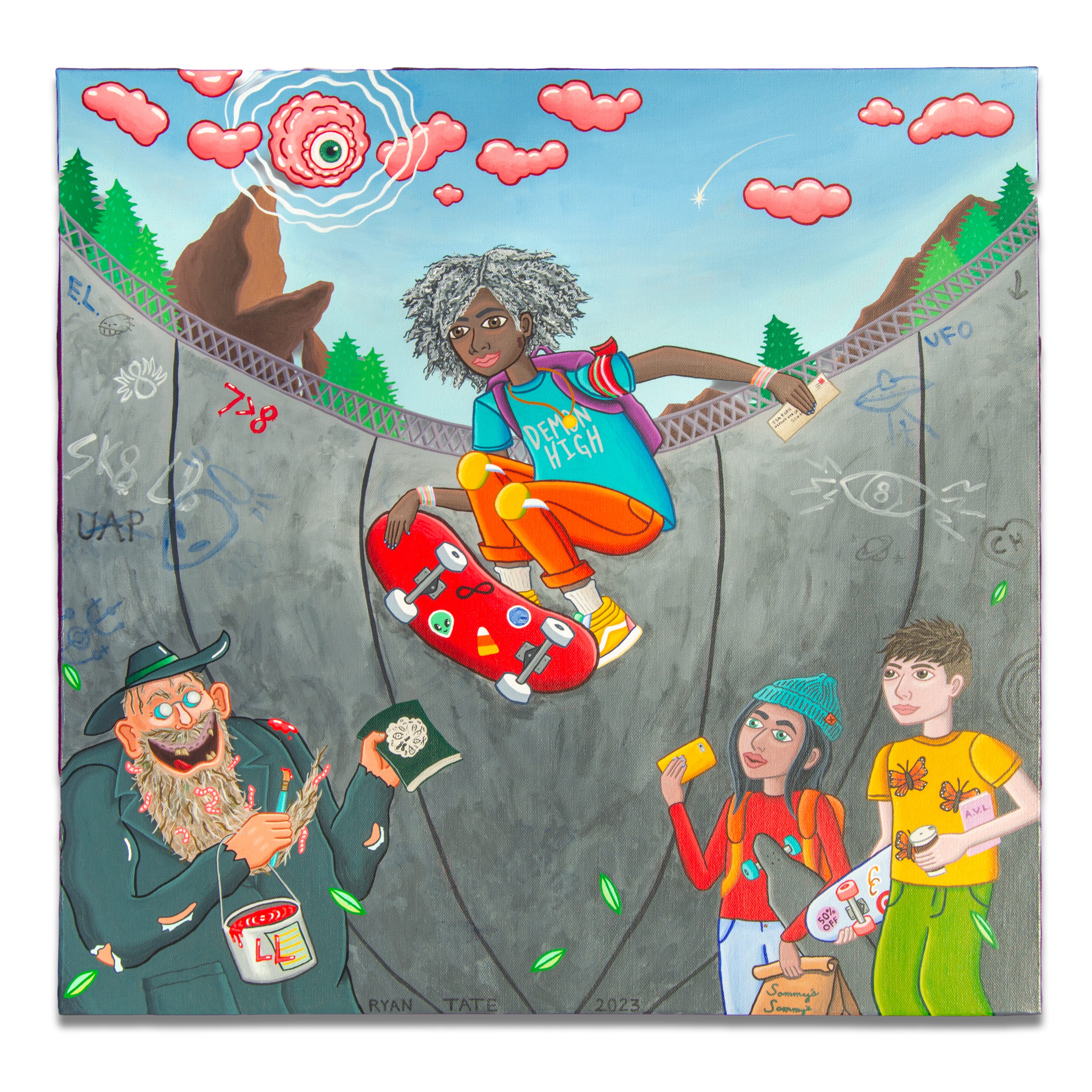
L8ER SK8ER is an upper-YA/crossover horror novel told in eight interconnected stories, set in Shimonah, Nevada -- a desert town a light-beam from Area 51 -- in the aftermath of the murder of a seventeen-year-old boy by an 8-obsessed cult member. Across a single scorching summer, five teenagers chase answers and belonging as strange new faces arrive in town, only to discover the most alien thing about the season is themselves. It's a queer murder mystery and meditation on fandom and obsession, skateboarding and transcendence, and it's woven through with gematria and Jewish mysticism from the book of Ezekiel to the Maharal to Bob Dylan's "Desolation Row."
The Interview
Evelyn: Well, let’s jump into it and talk about you a bit. Why don’t you just tell us about yourself, where you’re writing from, and what you write?
Elie: Sure. My name is Elie Lichtschein. I write horror, often with mystical or religious elements and angles. A lot of that comes from my traditional Jewish upbringing where I studied old texts, ancient Jewish myths, stories, and ideas, while also being obsessed with Goosebumps, Stephen King, and just horror in general. I found a nice fusion between the two because there are a lot of untapped or undiscovered Jewish horror ideas and monsters.
I’ve been writing horror for the last few years while having a day job. I wrote a kids’ horror podcast in 2019 called The Creeping Hour, which was fun and sounds like it would slot well into the world of your own story. But L8ER SK8ER is my baby. It’s a book that I wrote five years ago, and I’ve seen it go through a whole life without being born. It feels almost like the gestation period has been way, way too long. It culminates and brings together a lot of these themes that give my work shape: the Jewish mystical elements, the horror, the spookiness, and aliens. I’m very into aliens, and that’s a big part of the book as well.
Evelyn: Cool. Do you still like to read horror as well then?
Elie: I do, yeah. I’m a big horror reader. I try to read both current stuff (published in the last year or two) and also just classics.
Evelyn: What’s your favorite book that you’ve read recently?
Elie: I would say probably Nestlings by Nat Cassidy. It’s really good.
Evelyn: I think I’ve heard of that. I’m not a big horror reader, actually, but I do think I’ve heard of that one.
Elie: Well, he’s doing his own thing in the shadow of Rosemary’s Baby. A couple moves into a weird, haunted building, and similar to your book, there’s a cult in the building trying to get a baby out of these people… for fucked up reasons of course. It was a great one. But also, a lot of horror is short stories, so I often read anthologies that look interesting to me.
Evelyn: Cool. Nice. Okay, so now getting into actually talking about L8ER SK8ER—why don’t you give us a summary of the book, what it’s about, and who your main character is?
Elie: Sure. Although I should say from the outset that when my agent at the time and I tried selling it to editors, one of the reasons it didn’t sell as quickly as we hoped is because it had a lot of characters. It’s a novel that is also a bit of an anthology series with interconnected stories.
The main character is actually debatable, but it opens with a girl named Katie Korn. She’s 16 years old, a skater, and lives in Nevada in the middle of the desert, pretty close to Area 51. She’s a ridiculously talented skateboarder. Her friends go skating all the time, and they have this really cool skate park built out of a natural crater in the ground. But she has this talent that nobody can touch, and part of it is connected to her mom, who was also a skater, who raised her, and just disappeared one night in a storm. Katie tries this trick that she views as an homage to her mom, and she’s always close to nailing it, but she can never quite land it.
Then she starts seeing these visions in the sky shaped like an eight. She comes to this realization (with some help) that her mom was an alien whose natural movement is similar to skateboarding. Her mom came to Earth, was a crazy talented skater, met a dude, married him, had this baby, and then went back into “the Eight,” as they call it. It all has to do with the number eight. Katie goes after her mom trying to find her, but she also has to decide if she wants to stay here on Earth or transcend it to go to the Eight and be with her alien mom.
Evelyn: Okay. So, you said it’s a bunch of short stories. Is Katie the throughline, or are there several characters with transitioning perspectives?
Elie: Katie is the throughline; I used her story roughly as a spine for it. There are eight stories total—again, the theme of eight. Katie has the first story, the fifth story, and the eighth, final story. She’s referenced throughout, so she is there at the beginning, middle, and end, but we only get her perspective intimately in the first one. Although in some of the other ones, she is brought into the background or interacts with the other characters, because most of them live in her town and are skaters or kids she would cross paths with.
Evelyn: Okay, so who are the other characters that have perspectives?
Elie: One of them is a girl named Penny. She’s a 16-year-old true-crime writer who is obsessed with this cult in the community that worships the number eight. The story is set over a summer, and at the beginning of the summer, she broke a pretty big story involving this cult. She has since seen her readership blow up on a platform that would probably be Substack if I were writing it today. She’s covering this cult and a case involving a murder-suicide while managing a big influx of readers and all the good and bad that comes with that. She’s kind of a poser skater girl. Katie Korn is an incredible skater, but Penny just does it for the look.
Evelyn: Okay. She’s a writer—does she actually like skating, or is it just for the image? Does she secretly hate it?
Elie: It’s more for the image. She’s afraid of getting hurt. I think to succeed as a skater, you have to treat your body like it’s disposable. Tony Hawk once said there’s not a single bone in his body he hasn’t broken more than once. He’s a skating great, but it’s a horrifying concept. I would never try to replicate that.
Evelyn: Yeah, when I was little, my brother started to learn to skateboard and I wanted to try it. Then I realized that I might fall and I was like, “Nope, never mind.” So I guess I’m like Penny.
Elie: I had the same thing. I skated when I was younger, and I bought this ramp because I saw a skating ramp on a cartoon. I saw somebody selling it online and got it, but as soon as we got it, I realized that to actually go off of it, you were going to launch 15 feet in the air, which is horrifying. So I actually sent my younger brother down to try it first. Two stitches later, I was like, “I don’t think so.”
Evelyn: That’s so funny! Oh my gosh. Okay, so you talked about this a little bit, but what would you say the main conflict of the book is? Is it for her to find her mom?
Elie: I don’t think so. That’s the surface conflict. The bigger conflict is: do you want to leave what is comfortable to you—in Katie’s case, being human in Nevada with your dad—in order to pursue the unknown? For Katie, that unknown is a transcendent, alien, skating, humanoid type of mother who is shaped like an eight in her true form and moves through the universe on this bizarre, unfurling stream. It’s a very specific question for Katie Korn because it’s fiction, but I do think there are resonances for a lot of people: do you want to keep doing what you’ve always been doing, or do you want to break off and go after that new, different, strange thing?
Evelyn: Right. Has she ever met her mom before? Is her mom loving, or would she just leave without knowing her? Sort of taking a gamble that is.
Elie: No, her mom left eight years before the story starts, when Katie was eight.
Evelyn: Okay, so she did kind of know her.
Elie: She knew her, and her mom taught her how to skate. Her mom was a presence and then just disappeared without explanation. Her dad explained it away, but Katie was never satisfied with those explanations, obviously. Her dad didn’t really know either; he just fell in love with this cool skater woman and didn’t realize she was more than a human woman.
Fun Questions
Evelyn: Okay. I want to move into some more fun questions. When did you first realize that you needed to write this story?
Elie: That’s a really fun question. My story as a writer is a little similar to yours. I started in an MFA, and out of the MFA I decided to write middle-grade and focus on kids’ horror for a second. I used a connection at my MFA to get an introduction to a woman who worked at a podcast production company in Boston. I pitched them a podcast through my professor, and they basically gave me 50 grand to write five episodes of a kids’ horror thing.
Evelyn: Wow, that’s crazy!
Elie: I know, it was crazy! I was like, “Oh my god, this is amazing, this is how publishing should work!” That was the only thing that ever happened like that. But essentially, I came up with five stories for this podcast. Obviously, when you’re working on a season or a collection, there are ones that you save for later or put on the shelf. We had five ideas that became real stories, but a few extras, and one of those extras was L8ER SK8ER.
It was originally supposed to be a podcast episode for The Creeping Hour about a girl whose mom left when she was younger. She has this bizarre radio, and sometimes when she tunes it, she can hear a transmission that sounds like her mom from very far away. She’s a skater, and one night she hears a transmission telling her to come to the park to skate right now. She goes and she sees her mom, and that’s the story. We sold the first season of The Creeping Hour, and in my head, I thought this alien-radio-skater-girl story was going to be season two. They actually gave us the green light for season two, but then COVID hit, they suddenly lost funding, and everything kind of fell apart.
Evelyn: Yeah.
Elie: I felt the need to write this because I loved the idea of this girl missing her mom and secretly being the child of an alien. It was just speaking to me. So instead, I first thought of it as a short story, but then I was really drawn to number eight imagery because of what it represents in Jewish mysticism.
Evelyn: What does it represent?
Elie: It represents transcendence. There’s this cool idea in the Bible that points to the number seven representing things of this world, like the seven days of creation or the seven days you have to let certain animals live before sacrificing them because it’s considered a mini lifecycle. Seven represents the natural order of things. Eight, which is one above seven, represents transcending that order. There are a lot of examples in Jewish ritual ceremonies where the number eight signifies a miracle or something not confined by the laws of nature. The idea of a story called L8ER SK8ER with the idea of eight as an alien form of transcendence was just a cool concept I wanted to explore. I had to write it, and even if they weren’t going to give me money to make it a podcast, I was going to write it on my own as a book.
Evelyn: Very cool. If you had to describe the emotional core of the book in three words or a small sentence, what would it be?
Elie: That’s a great question. Katie’s emotional core is definitely “miss my mom.” But for the town, the core is that they are suffering because they have this crazy sacrifice murder cult. I think something about that would really be the actual emotional core of the book.
Evelyn: Our books are so wildly different, but that aspect alone is similar—not missing the mom, but the cult.
Elie: Yeah, that’s really cool. It’s such a fun idea, isn’t it? Cults generally interest me from a horror perspective, I love folk horror. I love the idea of an enclosed community where an outsider comes in, is met by bizarreness at every turn, and ultimately it’s revealed that the community wants them there to sacrifice them for nefarious purposes—like Midsommar or The Wicker Man. It sounds like you’re doing something similar.
Evelyn: Yeah, although it’s funny because in my book, they actually want her to leave, but they want the rest of her family to stay.
Elie: Well, that makes sense because usually in folk horror, the person who shows up doesn’t have a cool singing magic. They’re probably like, “No, you are going to cause problems, but your family is great.”
Evelyn: Exactly, yeah. What kind of reader would feel most at home reading this book?
Elie: I think a reader who likes aliens, who is interested in true crime, or someone who just enjoys spooky, weird stuff that is mostly explained but leaves some pieces for the reader to put together. That’s the appeal of telling a single story through eight different perspectives or a bunch of different characters. In a way, I guess I was trying to run before I could walk. Some would argue you should write a straightforward novel first, get it out there, and then experiment with form. But I was drawn to experimentation from the beginning. Like we said at the outset, publishing is very geared towards what’s recognizable and what has been proven to sell because of very specific metrics. Those metrics don’t really translate into art, what makes art beautiful, or why we write, which often has nothing to do with how much money you can make.
Technique/Editing/Drafting/Process Questions
Evelyn: What does your writing routine look like?
Elie: I write in the morning primarily. I’m sure you can relate, but there are a lot of aspects that go into writing generally. There’s drafting to get the word count, and then I always have a notebook open in front of me for note-taking, scribbling, morning journaling, or free thinking.
In service of a big project like L8ER SK8ER, I find that I’m freshest in the morning. On a good day, my friends and I base parts of our craft on filmmaker David Lynch’s process. He had this idea that a lot of people don’t understand about making art—he was talking about painting, but I think it applies to writing. He said there’s a lot of “loafing” involved. If you want to get a good hour of work done as an artist, you have to block out four hours, and that’s something you really need to plan for. So I try to have these sessions where I’m working from 9:00 to 12:00 or 9:00 to 1:00, even though part of that means going for a walk, hanging with my kitten, or watching a video lightly related to what I’m working on. It doesn’t always involve sitting down at a desk and writing. I do a lot of that in the morning, and if I’m feeling it, I’ll do it in the afternoon as well. On incredible days, I can have a third session by the evening, but that’s pretty rare.
Evelyn: Nice. I had not heard of that idea, but I think that is kind of how things function for me, so I’m glad that you said that. I feel seen.
Elie: Part of it is also that when you work a 9-to-5 or 9-to-6 office job and you’re trying to have a creative life outside of that, people tell you to write during your lunch break or in the morning. But you can’t just drop into writing for 45 minutes; you have to get your brain there beforehand. Some people can do that, and I envy them.
Evelyn: Sometimes I can do that, but most of the time, I find my best work is done in the morning when I’m fresh. I have to have enough time to sink into it before I write anything good. I can write “stuff” in 45 minutes, but it probably won’t be very good; it’ll just be “meh.”
Elie: Totally. Yeah.
Evelyn: What major changes to the story did you make since you started editing? Has anything surprised you?
Elie: After writing a draft, I find media that felt very spiritually aligned with my story—specifically Heaven’s Gate, the cult. I saw a documentary about them, read books about them, and did a deep dive. Afterwards, when I went back and revised L8ER SK8ER, I really played up those elements in the book’s cult, which is centered around the number eight and certain cosmic planet factors that tie into the alien mom. They have a lot of rituals, like celebrating every eighth day like a holiday, stuff like that. Cults are so inspiring for writing. The theology is so rich that a thousand people could write 50,000 incredibly different books on it.
Evelyn: Yeah, there are several books taken on that. I think it’s just because they are so terrifying even just to think about casually.
Elie: That’s also the dark side of what I’m writing. It’s beautiful to think that seven is planet Earth and nature, and to become an eight, you’re rising above it to go to your alien home. But in every real-world cult that has preached a similar weird theology, going to your alien home always means suicide. And that’s obviously not what we’re trying to do here.
Evelyn: Yeah. What has been the hardest scene to write, either emotionally or technically? Don’t worry about spoilers right now; we can edit them out later if you want.
Elie: The character I mentioned earlier, Penny the writer, has a puppy crush situation with a boy named Tori, who appears in the first story but whose perspective takes over the second story. He’s about 14 in the story, and this whole thing was based on a real crush I had when I was roughly his age. Writing parts of that romance, which were lifted very neatly from my real life, including certain embarrassing aspects, made it a little hard.
Also, his whole story is written in the second person, which was really fun but a total shift from the straight third-person of Katie Korn’s opening story. That wasn’t really a hurdle because I actually really like writing in the second person. People think it tends to defamiliarize the writing, but I find that it really makes it more intimate.
Evelyn: Yeah, it can make it very intimate. I have a friend from Pakistan who wrote a memoir about her relationship with her mother, and how she put a lot of pressure and expectations on my friend when she was young. She wrote it in the second person, as if you were her, and it was really powerful. Second person can be amazing if it’s done right.
Elie: Totally, yeah.
Evelyn: We talked about this a little bit, but I want you to elaborate more. What do you do if you lose confidence in the project or if it takes a new direction?
Elie: I think there are three things. Number one: you need friends who gas you up when you’re feeling down. That’s very real in life, but definitely as an artist who’s in the early stages of their career.
The second thing is that a lot of people who write have created other art in the past. Sometimes, if your current thing isn’t working, it’s important to go back and look at something you made that you know you love—whether it was published somewhere cool or just has deep personal meaning. I used to write a lot of songs, so when I got stuck on L8ER SK8ER and thought, “This is stupid, nobody wants this,” I would play this super DIY track I recorded for myself back in 2007 and never showed anybody. That would get me back in the mood.
The third thing is just consuming art that you like. When I was stuck on revisions, I would go back and look at Heaven’s Gate stuff or other cult dynamics to get inspired.
Evelyn: [laughs] When you need inspiration turn to a cult!
Elie: [laughs] Yes, you turn to the leader! (Obviously that’s a lie, nobody should actually join one—cults are bad, and high control groups should be avoided—but in fiction, it’s a lot of fun. That was really enjoyable about the book because I got to write out the theology of the Eight Cult. We see it tangentially through the perspective of one family that was part of it, and that was really fun.)
Evelyn: How did you go about writing the lore of this cult? Did you have a rules list, or did you just keep it all in your head?
Elie: I kept it in a bunch of notebooks. It would be really hard to go back and find everything because the notes for L8ER SK8ER are probably spread across twenty-five different notebooks in my parents’ house and all over the place. But of course, when you’re working on it, you keep notes. I usually have a physical notebook and a digital document open that I can put it all in.
I also tied it to another element in the world. There’s a very minor character whose mother left her when she was young, similar to Katie. That woman grew up to become a very famous comic book writer in the world of the novel, and some of the characters are really into her books. It’s later revealed that she was actually a member of this cult, and she wrote about it inside her comic books. Beyond that, a lot of it was modeled on Judaism. There’s also a character I haven’t mentioned who is the Jewish heart of the story, and she’s a bit of a foil to Katie Korn.
Evelyn: Are all of your perspectives female? Never mind, you already answered that when you mentioned the story in the second person.
Elie: There are three female perspectives: Katie Korn, Penny the writer, and Elul: the girl who picks up the penultimate story in the book. She’s a queer, Jewish girl from New York who is going through her own stuff. But there are also two boys who get their own stories: Tori and Spoord. Then there’s one story that I really like which tells the story of the murder-suicide the cult perpetrated, written from the perspective of five boys who were all kind of bro-y high school juniors.
Evelyn: Interesting. My last question: what has this book taught you about the art of storytelling?
Elie: Man, that’s a great question.
Evelyn: That’s why it’s always my last one.
Elie: I think that for bigger projects, you need a certain degree of patience. We’re doing this interview in June 2026, and my baby isn’t out in the world yet. I think at some point L8ER SK8ER will be a book, but patience is so important because it’s just a longer process than you could ever want it to be. That involves getting it published, but also the writing of it. I had the idea inspired by the podcast, wrote a draft, put it down for 10 months, got inspired by something else I was reading, and then went back with a big burst of enthusiasm. That process could have easily taken two years instead of 10 months. There are other projects on my shelf where I know I just need to read the right thing to open them back up. So I would say patience is the main thing I learned.
Evelyn: That’s a great point. With my book, I wrote it and then took a couple of months off for the holidays. I thought I’d have it done in a year. Then a year came and I realized how big of a problem I had created, and that I was going to need at least two more years. We’re getting up to the three-year mark now, and I’m still wondering when it will be done.
Elie: I think many of us work best within some kind of human structure, whether it’s an MFA program, a NaNoWriMo situation, or having friends as writing buddies for accountability.
Evelyn: Yeah, or a writing group, whatever it might be. I have a friend who has been working on his book for 10 years. I actually interviewed him, and it’s good, but I’m just like, “Are you ever going to finish it? I want to read it!”
Elie: Can I say one more thing about the book?
Evelyn: Yeah, absolutely! Please.
Elie: I just wanted to mention that the two main characters act as foils for each other because they are facing a similar conflict. You have Katie, who is an alien inside a human body, deciding whether she will stay or go. Then later on, you have Elul, a daughter born to parents who had seven sons and really wanted a girl. She was a kind of extraterrestrial IVF implant, so she is also an alien. When she reaches a certain age, she is faced with a similar question: does she want to learn more about where she came from, or does she want to stay in her New York life with the family and Earth that she loves? Katie makes one decision, and Elul makes a different one. I liked that this structure gave me the ability to explore both paths, whereas normally a single character faces a conflict and can only act one way.
Evelyn: What do you think this story would have looked like if you had kept it in one perspective? Whose perspective would you have chosen?
Elie: It would have had to be Katie’s. But it would look very sad to me because all of these other characters I came to know and love wouldn’t be a part of it. Sure, I would know a lot more about Katie’s intimate thoughts and her life, but writing multiple characters and spending time with different people helps you know the setting better.
Evelyn: I agree completely. Having multiple characters helps you know the place you’re in, as long as they are in the same location. If you think about Carrie, for example, there are so many different perspectives, but you really knew that town by the end.
Elie: Totally. Agreed.
An Excerpt from L8ER SK8ER
<Converted Tub Thot-Dreams> <L8est on Phee> <Rush to Pub> <Not Weird Yet>
That whole summer, Penny felt the eyes on her. It was the cost of virality, she discovered early, and it took a week of re-socketing to learn how to fulfill her readers’ expectations sans rupture. The true-crime public was surprisingly aggressive, it turned out, in engaging with a newly crowned voice. It was fine, and it would be fine, but the massive glare of meticulous scrutiny brought out her badder behaves. Case in joint: Bryan gave her the weed just that afternoon and she immediately buried it in a Ziploc under Monica’s bouganvilleas, planning to save it for the weekend, and though all evening she tried her Penniest to be good girl, focused and productive, at twenty-three past midnight, with the house, block, and world silent as a hyperthymesian alien antenna breaching a boy’s temple <with eyez skized and intrusives electric> her inner alarm chimed baddy o’clock. Crank the roof, smoke the herbal, pour the Hula Girl, soak the night shades, dream the thots, soap the hips, plot the overthrow. Anything to avoid her actual work, which was finish writing the dead-hearted thing.
Usually, a visit to the third-floor bathroom brought Penny out of even her darkest brambles. Especially since October, when Dad and Lindz built it out, adding the heated stone floor, standalone blue-tiled bidet, and most haloesque, the convertible roof directly over the bathtub, her personal hollow of heaven. The hinged patch of ceiling was designed to open until it collapsed flat, a rectangular space 72 x 42 inches, large enough to let in the universe, which Penny learned the hard way in April, landing in major Monica jail after getting super high at 2 a.m. on the eve of a deep-basin downpour and, like a total dipshit, forgetting to close the ceiling before bumbling back to bed. But even with illegal smoke coiling up her fingers, escaping through the open roof into a sky close enough to touch, the reliable panacea <Pena-Cea??> of settling stressed body into cool porcelain full of warm water failed her.
It was the current Phoebe. Like each post since her breakthrough, writing it half turned her out, but this time it also netted something else, something especially ennuied <especially especially en oui’d>. Penny tipped in more gel from the pink bottle and splashed back into the warmth. Her hair spread out to sudsy eye level, a throwback to when tubs were twice her size instead of three-quarters. The grandness of the universe pulsed through the modified overhead, distracting.
A high-beam surfaced, aided by the drenching THC: how could life not exist above nature and comprehension? Penny rarely lent brain space to extraterrestrials <the Ungodly Ufologist of Utah excepted> but sometimes at night, usually when she was stoned to her bones and especially especially when she was procrastinating, the want of their existence wore her tighter than the A&E leggings she hadn’t touched in a year. It would be a relief and a half to know that above life forms existed when so many of the below ones were shattered, corrupted, or just plain RA-ful.
And, as of June, chillingly local. Penny abhorred adverbs on principle but that one worked since it held her and her two best friends super tight, two closer than the third, just like in real life <LL y L>. In the tub, the girl giggled, happy with herself and her high mind. Writers are cool.
Unlike this summer’s anti-trophy. Phoebe Phuckface. A member of the cult, if a thirty-year-old photo currently yellowing under the removable hatch of Penny’s sock drawer could be trusted—and five national papers and three dozen locals decided last month that it could. Not to mention two calls to appear on national news shows, though Penny opted out of the second immediately after the first. <Use hashtag #Holyshitthatwascringe to forget the fifteen second CNN clip from the segment apparently on how inarticulate and um-filled bracefaces can be on the cliff above diecisiete>
Penny sipped the burning paper like her morning Genmaicha. Her soapy perch on the third floor of the Tepje home at 125 Lemon Drive, Shimonah, NV, 88908, late night–slash–early morning <first Monday in Augy for all you when-ers> was the perfect place to soak in the empty world and chase shapeshifting thot-dreams. Thot not like thot but thought, a spelling she loved for its salacious misdirection. She decided around the time her star was first rocketing that the traditional spelling of the word only served to ugh it, which it also happened to do technically. Thank Bryan for the tip, for the song, for the weed, for so much this summer.
When the joint neared its end, Penny stood up. Her swinging hair bulleted droplets onto the tiles and walls. She took a final pull and flicked the butt through the open ceiling and onto the dark below. Her fuzzy robe hung over the closed lid of the toilet, and she pulled it on without bothering to dry off.
Mentally sighing at the work still ahead, she spiraled the convertible crank <courtesy of Tepje & Daughter Wooden-novations! Use code FAMDISCOUNT to justify nepotizing the best bath in existence!> and lowered the renovated roof until it settled into place, quiet as a curtain, sealing off the house from the elements. Satisfied, she locked the chain, pulled the bath drain with her foot, and swigged a cheekful of spearmint mouthwash in case Monica was up.
It was late enough that Penny would be shocked if her mom was awake. Linz and Dad could care less that she occasionally stumbled down from the third floor, eyes redder than sky streaks, but Monica pressed charges like it was her job. Which it was, but still. And yet as long as the state of Nevada’s Cannabis Compliance Board maintained its prohibition against sixteen-year-old true-crime obsessives from buying legal weed until Halloween of their year twenty-one, the founding partner of Rosenschein, Tepje, and Chavataro LLP responded to any hint of the stuff on her younger daughter like the war on drugs was alive, thriving, and worst of all, litigable.
Absolutely worth it, though, a thou for a thou. Young obsessive writer types <como yo> and young obsessive reader types <como Bry-o> were alike in that both needed the high like how the 1970s stalker needed the shrub. Bryan kept coming through all summer, best co-counselor a girl could ask for, and the only thing she did ask when filling out her Longsaw placement form in May was that she not be paired up with someone who might aggravate a made-up peanut allergy. This was covertly-slash-obviously geared at R., scion of a successful buttery. Bryan, in addition to not being a loser-buser, charge one, was a perfect trick mirror, reflecting a warped version of her, artist masquerading as audience. A genuine brainiac never bereft of bud, overflowing with manic rambles about music, books, film, and art between jet plumes of white.
Penny opened her bedroom door. Her room was mostly dark, but a light glowed from the dresser. Papa Herff, paused mid-lecture. She’d played his videos so many times that they looped into a jumble, distinctive only by a favorite line here or there, jabbing from the screen like a 3D thorn. She sat at her desk, world swimming slightly, and folded her legs under her, copying the pretzel style “appendage origami” she learned last year at Maria Hart-Garczon’s yoga-themed birthday sleepover. Low-key hating herself for how much she hated working, she fought every oppositional impulse in her veined lineways to pull up the post she’d been ducking all evening in increasing increments of non-productivity before deciding to free her mind in inspiration rather than reward and light up in the tub under the sky.
Writing was its own track, but finding an audience helped. Following a jitter-generating influx of readers the first week of July, Penny’s page views continued to swell. All because of her exclusive on Phoebe Phee, that shit-stained monster in human clothing <whose hellishness started at the elbow and dripped down her hand>. It was traffic she totally earned, deducing the killer’s past allegiance to the 8s on memory, past reportage, and luck, and it didn’t matter how aggressively a spelling-challenged commenter ranted under a July 13 Los Angeles Times article against “waffle-tttied jailbait soccial justice she-warriors.”
The Slaughter of Cantor Drive had already entered the true-crime canon, judging by the sites and feeds and multiplying threads and YouTube playlists Penny scoured daily. She planned to twist her ropes tighter round her readers’ necks, but to do that she had to first get it out, no matter how much it nagged like schoolwork or how tightly tethered her high-brain felt to the skies.
She clicked on her website and caught eyes on the banner.
PENA’s TRUE CRIME RA’RCHIVES
Right now it read like a minty mouthful <don’t trust hi thots not confirmed by dry thots> and Ella, that buzzing queen bee of annoyance, never failed to bring up the possibility of a name change. But it was inarguably an improvement over Penny’s first stabs at self-branding. She tried incorporating her entire first name, but PENA’S (P)ACCUMULATED (NED) DEAD AND RED ARCHIVES was too long and THE PEN, THE (A) PAN AND THE DEAD RA was too dead bad.
Under the banner was a skiddily good drawing of a hand whose fingers each showed the five different stages of human decomposition. It was the first piece of fan art she ever received, following her post on the decompositional rot of the Jane Doe of Dane Cho, who she’d tagged as THE GASH-HEARTED HAIR-SNIFFER. <Revisit the gory details here but also don’t because of how it chased sleep that first night, the gut-voiding of what comes up with pulled out hair> And under that, her website’s tagline, tucked between her trademark electrics <because parentheses are lamer than parents’ theses and also SEO is birdshit>:
< THIS WORLD IS A HIDEOUS PLACE >
A direct quote from a hard-to-track source. Penny heard it in person a long time ago from a circle-obsessed woman who disappeared without a feather-fall of warning, less than ungoogleable, with no real name.
This world is a hideous place.
It was dark, but was it untrue? The earlier view from the bath might throw an X, but seeing the seething things <words and stories of knives and guts> alone in a cave-like room darkly lit by the skull of Papa Herff provided grave affirmation. Monica had told her often enough to pull her head from the shit gutter and stop combing trash culture, but that was before July, and since then she’d been gloaty and mom-proud, annoying but also not. Also also, Penny didn’t see much difference in studying gore for pleasure <slash writing practice> versus studying it to deliver despicable clients diminished sentences, which her mom billed sky-high for. Penny’s years of extracurricular studies had yielded the one consistency, over and over: People sucked. At best, they were full of closeted RA they never acted on, and at worst, they were Jeffrey <Dahmer, Epstein or Bezos, take your pick, preferably an ice one to the skull>. Bad bones brushing up to the skin’s surface, bruising and staining before breaching in bloody pricks. Penny was cool being proven wrong in light of new facts, as any decent reporter must be, but her studies squirreling into the dark recesses of the human psyche made her confident that even if aliens existed, the most violent and unspeakable acts in the entire out-ranging cosmos were and always had been anthropogenic.
Penny skimmed the paragraphs she’d been piling all evening with only rare bursts of progress. The post was mostly made up from re-spun info from that day’s Review-Journal, although Penny tacked on a few details the reporter missed and in two instances had gotten ass-out, flat-up wrong.
She scrolled and highlighted, Ctrl C’ed and V’ed, cut and reworded, tightening and tautening the existing body—aka revision, the shittiest, non-Penniest part of the writer’s way, but a necessary RA. Semi-satisfied, she aggressively and liberally cross-linked the seven other Phoebe posts she penned throughout the summer, all in the titanic shadow of her first iceberg article, 750K views that first week. <click here to fail again to fully absorb the !!! of it all> This thanks to a hyperlink in a New York Times article. What they called “a grisly South Nevadan murder-suicide,” Penny’d named “The Slaughter of Cantor Drive,” which doubled as the title of her first Phoebe piece. One of the earliest bits of feedback she got was for her third-ever post. It was on the murder of Jun Lin, and she’d called it “The Cannibal of Canada.” The sole comment came from @LeafWieldingCanuckieROY and read “I live on rue morgue road in calgary, situated in edmonton in the prairie provence of western alberta on the northern continent America on the upper hemisphere of earth and have the one q - where the fuck is ‘canada’ ?? precision please.” Writing lesson: In titling, pinpoint details hit hardest. Which, laughable that a Penapanedra would need to learn that, but just because things were funny didn’t mean they were overstated.
Penny’s phone dinged. Not the site notification for her RA’RCHIVES—she’d tuned those to the song of the summer, a rumbler from 1965 <the year of Sylvia> called “She Belongs to Me”—but the generic sweeeee of an incoming text. And then two more, one after the other.
Glad for the distraction, she flopped onto her bed and handled her phone, which was plugged into the wall.
1:04
Yo
You got 11 dollar bills
?
It was Ella. Keeping the bit lit, a flick of the candle.
Glowing, Penny thumbed her a palm.
1:05
Nah I only got 10
y right now they belong to phoebe phuckin phee
I swear she’s proof zombies exist
All this life after death
1:06
Sounds like you’re drawing conclusions
On ze wall
Penny laughed out loud.
1:07
The only conclusion =
She got everything she neeeeeds
She’s an artist
She dont
look
back
1:07
Okay but hear me out
What if ze boy’s just a raven
At your window w a broken wing ?
1:07
What does that even mean
1:07
Idk
Arent ravens young ?
1:08
Arent ellas noisome ?
:-P
1:08
Arent babies babies ?
1:08
Wtf ella how is he a baby
He’s obsessed w boy robe
1:08
y… ??
Babies love baby shit
Penny squirmed, caught. She walked right into that one. One of the worst things about her Ls was that they’d outgrown their Boy Robison standom, an egregious oversight that had her semi-seriously considering founding a new friend group, call it a collection of Bs, Bryan first and front. Sometimes Penny felt like she couldn’t relate to people who weren’t formed in part <or totality> by Boy and his creator.
1:09
Also what’s up w Ruben ?
Cn you explain ??
Me at least ?
1:11
???
Penny put down her phone. Her head hurt suddenly, and her corazón wasn’t lagging. She wished Ella hadn’t brought him up. Both hims, but mostly the one that didn’t matter and was stained shit-brown between the electrics of thought and memory <Mo! and No! are galaxies apart>. She felt a jut of phantom whiplash from that ugly name unexpectedly flung at her. A pivot, turn of thots to the better, the new. Avoidance through escape. She didn’t know the gap, but even if it spread bigger than Monica and Dad, it didn’t feel weird. And Penny knew weird—that night with R. had been a whole inter-bred backwoods family of weird. Not first, but l8er d8er, full sob, when she followed him to the basement, where she was then on the ground somehow, listening through the wall to pitter-patters on the asphalt, a pitiful backdrop to her own soft assault. Avoidance through body voidance. Her pen was shaking, but the words came steady. With butterfly boy it felt … nothing like that. Not weird, not yet. And that was enough for her to ignore her friends, her advocating devil, and for a summer-long moment, the world. Avoidance through silence.
She texted Ella that she had to finish her post and wished her a gn.
Yawning, Penny returned her top to the top on her lap. It was a camp night, which meant she had to string a few 60s of zzz before ripping her eyes open for work. She reread her draft, changed a word, tweaked a phrase, and, deeming it good enough to show <but maybe not book>, she scheduled a drop for the morning. She paused at the “publish” button. It was the best part of her website. The one great circle, seeing her out of her bedroom and into those around the country and world, shout out to her super-engaged Indonesian readers upping her South Asia stats. She pushed the button and it winked at her, gleaming as green as the pair of ripped Soffes she pulled on immediately after. She climbed into bed, giddy with looming sleep, mouth still squeaking in cleanliness. She unpaused the video of her favorite cult leader <every true crimer has one>, muted it, and snuggled against her chenille comforter, relaxing into its softness.
She was asleep before you could say her name.
Conclusion
Thanks so much for reading! Check out elie lichtschein 👽🛹!
 | A guest post by
|
omg cooooooool holy shit holy shit holyshit it’s up!!!!